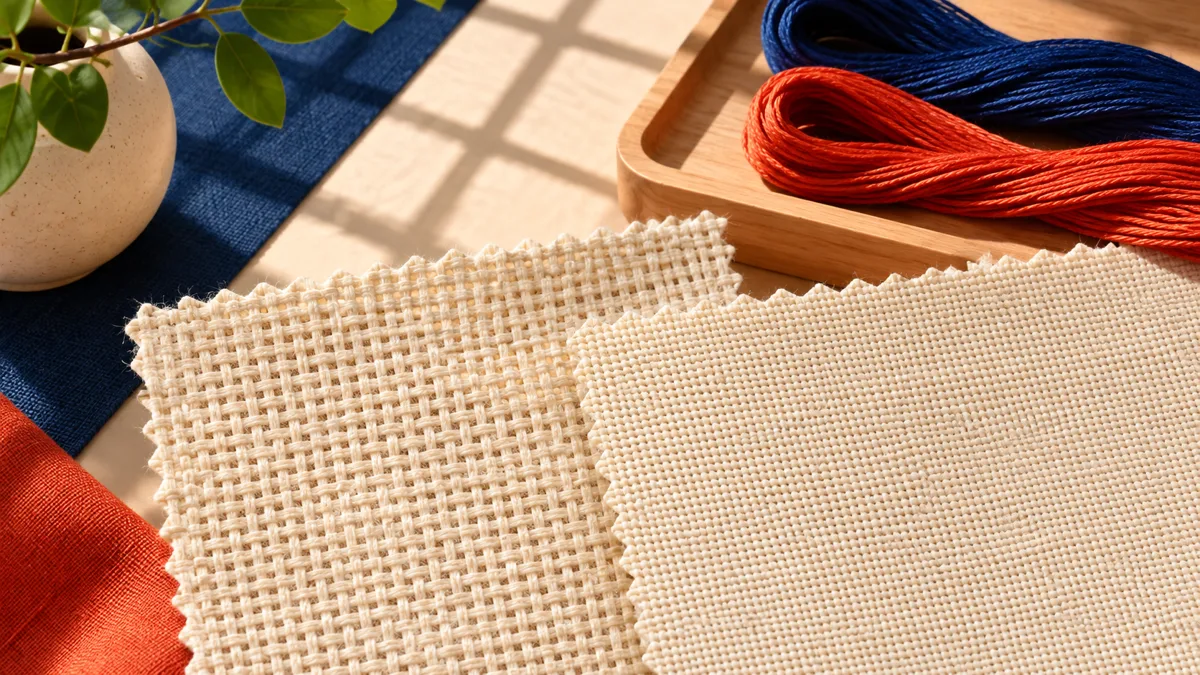
Use the right count
DMC defines Aida count as stitches per inch and lists 14 count/5.5 points per centimeter among its options. Do not confuse that embroidery grid with a general bedding thread-count claim.
Calculate an original example
A hypothetical 140 by 112 stitch rectangle on 14 count Aida spans 10 by 8 inches. Adding 2 inches of margin on every edge gives a 14 by 12 inch cut before any shrink allowance.
Keep fabric types separate
An evenweave worked over multiple threads needs an effective stitch count appropriate to that setup. Our simple tool uses entered stitches per inch and does not assume every fabric is one square per stitch.
Use effective stitch count
On 14-count Aida, a 140-stitch-wide design spans 10 in before margins. Another fabric may list threads per inch rather than your actual stitched squares per inch. If a technique spans multiple fabric threads, enter the resulting effective stitch count rather than treating every thread as one completed stitch.
Compare counts with a fixed design
For the same 140 x 112-stitch example, 14 effective stitches per inch gives 10 x 8 in, while 16 effective stitches per inch gives 8.75 x 7 in. These are geometric alternatives, not a recommendation that either fabric is suitable. The design can change physical size without changing its stitch count. Thread choice, stitch setup and the authorized design instructions remain separate decisions.
Count the unit actually used
A product description may state a fabric count while your stitching method uses more than one fabric thread per stitch. Before calculating, determine how many completed stitches occupy one inch in that setup. The tool expects that effective value. It does not identify an unfamiliar fabric from its photo or automatically translate every evenweave construction into Aida-style squares.
Keep rounded catalog values separate
DMC presents 14 count alongside 5.5 points per centimeter. Using 14 per inch in the tool and converting the resulting physical dimensions with 2.54 cm per inch avoids silently swapping in a separately rounded catalog value mid-calculation. If your actual measured grid differs, enter that effective count as your own measurement and keep the measurement method in your project record.
Before you decide
- Keep family, color/SKU and actual quantity
- Separate nominal, usable and assumed measurements
- Read component care and current seller conditions
Sources & scope
Checked November 4, 2026. Manufacturer and retailer references support the specific statements. Dated displayed prices are not final checkout quotes, performance rankings or material testing. This shopping reference does not replace the product label or material-specific care or seller cut conditions.
Keep reading
Nominal fabric width is not confirmed usable width ↗